The dream of a seamless European journey, where you can travel from the charming canals of Amsterdam to the ancient ruins of Rome without a single border check, is not just a fantasy it’s the reality created by the Schengen Area. This revolutionary zone, named after the small Luxembourg village where the initial agreement was signed in 1985, represents one of the most significant achievements of European integration. If you are planning a European adventure, understanding the Schengen countries list and its regulations is the essential first step.

What Exactly is the Schengen Area?
Often mistakenly conflated with the European Union (EU), the Schengen Area is a distinct region composed of European states that have officially abolished passport and all other types of border control at their mutual borders. Think of it as a single territory for international travel purposes. Once you enter one of the countries on the Schengen countries list. You are generally free to move throughout the entire area for the duration of your visa or authorized stay without facing further immigration formalities.
The Fundamental Benefit
The primary advantage of the Schengen arrangement is the freedom of movement for citizens of the Schengen states, other EU/EEA citizens, and visitors from third countries. This means a single visa—the Schengen Visa—grants access to the entire Schengen countries list.
The Official Schengen Countries List
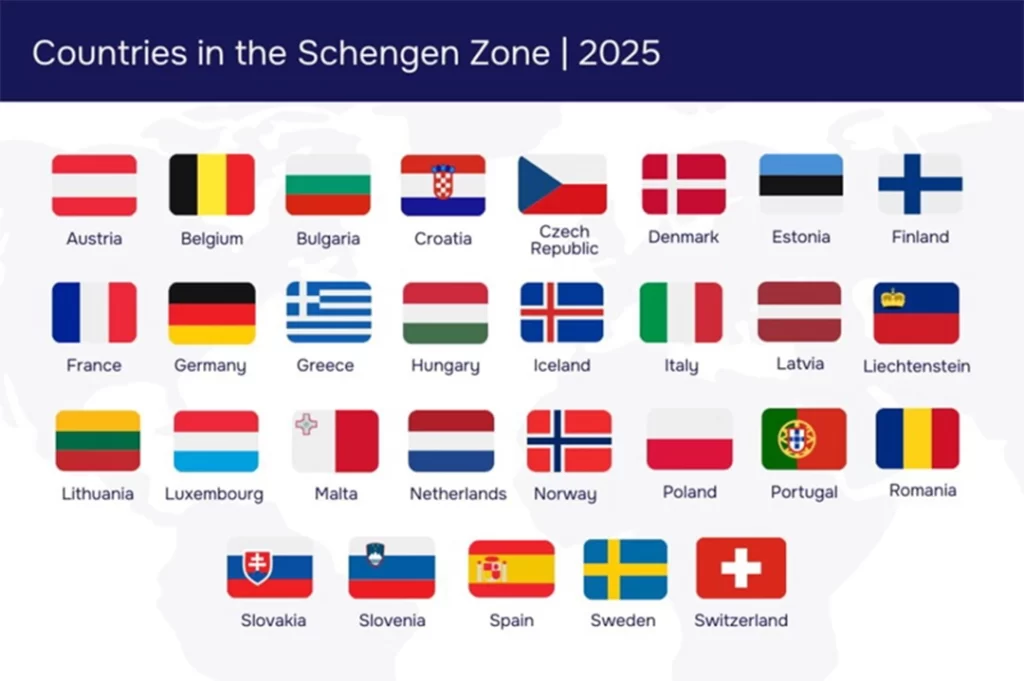
The Schengen countries list is dynamic, but currently, it comprises 29 European nations. It’s important to note that the membership is a mix of EU member states and non-EU countries, which can sometimes be confusing for travelers.
Current Schengen Members (29 Countries)
Here is the definitive Schengen countries list, categorized for clarity:
· Most EU Members:
The vast majority of European Union members are part of the zone, including major travel destinations.
· Austria
· Belgium
· Croatia
· Czechia
· Denmark
· Estonia
· Finland
· France
· Germany
· Greece
· Hungary
· Italy
· Latvia
· Lithuania
· Luxembourg
· Malta
· Netherlands
· Poland
· Portugal
· Slovakia
· Slovenia
· Spain
· Sweden
· Non-EU Members (But Schengen Members):
These countries are not part of the EU but have chosen to integrate into the Schengen border-free zone.
1-Iceland (Nordic Passport Union)
2-Liechtenstein
3-Norway (Nordic Passport Union)
4-Switzerland
Navigating Common Confusions: EU vs. Schengen
A major source of confusion for travelers is the difference between the European Union (EU) and the Schengen Area. They are not the same!
1-| Membership | 27 Member States | 29 Countries (The Schengen countries list) |
2-| Non-EU Members in Schengen | None | Iceland, Liechtenstein, Norway, Switzerland |
3-| EU Members NOT in Schengen Ireland | Bulgaria, Cyprus, Romania (pending full membership) |
As you can see, countries like Ireland are in the EU but have opted out of the Schengen agreement, maintaining their own border controls. Conversely. Switzerland is not in the EU but is a crucial part of the Schengen countries list. Always check the specific Schengen countries list rather than assuming EU membership equals Schengen membership.
The Schengen Visa:
For non-EU/EEA citizens who are not visa-exempt, the Schengen Visa is the single required document for short stays (up to 90 days in any 180-day period) across the entire Schengen countries list.
Key Rules for the Schengen Visa
· Where to Apply:
You must apply at the embassy or consulate of the country where you will spend the longest duration of your trip. If your stay is equal in two countries, you apply to the country you will enter first.
· The 90/180 Rule:
This is critical. You are allowed a maximum of 90 days of stay within any 180-day period. This is calculated across all countries on the Schengen countries list. Once your visa is granted, your time starts counting from your first entry into any Schengen country. You must track this yourself!
· Proof of Funds & Insurance:
All applicants must demonstrate sufficient financial means to cover their stay and provide proof of travel medical insurance valid throughout the entire Schengen countries lists with a minimum coverage of €30,000.

The Latest Update:
The Schengen countries lists recently saw an expansion. On January 1, 2023, Croatia formally joined the border-free zone, becoming the 27th member. This was a significant moment, meaning that land, sea, and air borders between Croatia and other Schengen members were lifted. Additionally, in March 2024, Bulgaria and Romania joined the Schengen countries list for air and sea travel. Land border controls remain, but this partial entry is a major step towards full integration.
As the world continues to evolve, the Schengen countries list may expand further. The political will is strong to complete the project. Eventually including the remaining EU members like Cyprus into the full Schengen countries list.
In conclusion, the Schengen countries list is more than just a roll call of nations; it is a testament to cooperation and freedom. Whether you are a first-time traveler or a seasoned explorer, grasping the rules of this zone is the key to unlocking an unforgettable, hassle-free European adventure.
For More Information: https://www.uniguidepk.com/it-courses-in-sweden/