

The international education industry has reached a defining moment in South Asia. The Government of Nepal has officially approved the Educational Consultancy, Language Teaching and Preparatory Classes (Operation and Management) Regulations, 2026, introducing one of the region’s most comprehensive legal frameworks for education consultancies, language institutes, and test preparation centers.
The new regulations represent a major step toward transparency, accountability, student protection, and professionalization of the overseas education sector. For education consultants, universities, students, and policymakers alike, Nepal’s decision is more than a domestic reform it is a benchmark that neighboring countries, including Pakistan, cannot ignore.
At UNI-GUIDE Consultancy Services, we have consistently advocated for a regulated, transparent, and accountable international education industry. Through awareness initiatives and industry discussions, we have emphasized that legalization is not about restricting businesses it is about protecting students, raising professional standards, and strengthening the credibility of the entire sector.
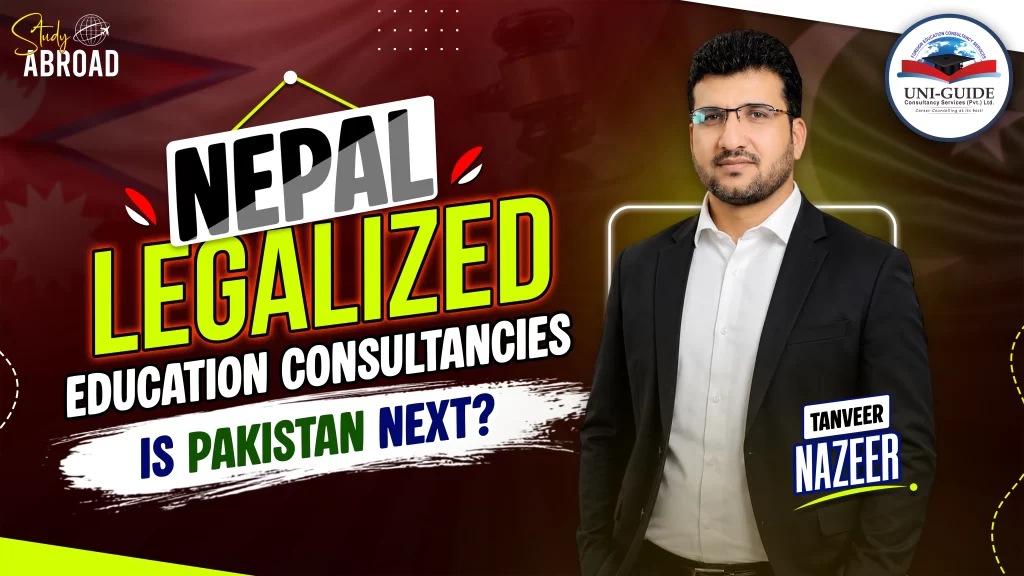
Under the newly approved regulations, every education consultancy must now obtain official approval from Nepal’s Ministry of Education before commencing operations.
The licensing requirements introduce substantial financial and operational commitments designed to ensure that only serious, compliant, and financially stable organizations enter the market.
To receive an operating license, an education consultancy must:
These financial requirements demonstrate Nepal commitment to ensuring that education consultancies possess adequate financial capacity and remain accountable for the services they provide.
Perhaps the most significant aspect of the regulation is its focus on protecting students.
Education consultancies are now legally required to:
Most importantly, if a consultancy’s negligence results in a student becoming stranded abroad, or if it recommends an unauthorized or fraudulent institution, the consultancy itself can be held financially responsible for compensating the student’s losses.
This introduces a level of accountability rarely seen in the region and places student welfare at the center of the regulatory framework.
Qualified Counselors Only
The regulation also professionalizes educational counseling.
Every education counselor must:
This ensures that students receive guidance from trained professionals rather than unqualified advisors.
Licensed institutions must also meet strict operational requirements, including:
These requirements reinforce professionalism and improve the overall student experience.
The regulations further require that all financial transactions be conducted digitally, significantly reducing opportunities for financial misconduct.
Consultancies must publicly disclose all service charges through:
Such transparency enables students and parents to understand fees before making any financial commitments.
Another notable provision is that education consultancies must operate under Nepali ownership.
Organizations with foreign investment have been given one year to convert to domestic ownership, reinforcing national oversight of the education consultancy sector.
Operating licenses will remain valid for only one year.
Institutions must:
Failure to comply can result in financial penalties, automatic cancellation of licenses, and forfeiture of security deposits.
The Ministry of Education now has the authority to suspend or cancel licenses if institutions:
These enforcement powers significantly strengthen consumer protection within Nepal international education sector.
The regulations also introduce a grading system.
Consultancies will be evaluated based on:
Institutions will receive Grade A, Grade B, or Grade C ratings.
Additionally, Nepal’s Ministry of Education may identify high-risk foreign institutions and prohibit consultancies from sending students to those providers.
This creates an evidence-based quality assurance system that benefits students and improves industry standards.
Nepal’s decision raises an important question for Pakistan.
Pakistan has one of South Asia’s largest outbound student populations, yet the education consultancy sector still lacks a comprehensive national regulatory framework comparable to Nepal’s new model.
Over the past several years, concerns surrounding unqualified agents, misleading information, unethical recruitment practices, and student exploitation have repeatedly highlighted the need for structured regulation.
Organizations such as AFEIC have consistently advocated for the legalization and regulation of Pakistan’s overseas education consultancy industry, emphasizing that standardized licensing, counselor qualifications, accountability, and student protection are essential for building a credible education ecosystem. These discussions have focused on creating a professional framework that benefits students, universities, and responsible education consultants alike.
Nepal’s reforms demonstrate that regulation is both achievable and beneficial. Rather than creating barriers, effective regulation builds trust, enhances international credibility, and encourages ethical competition.
The approval of Nepal’s new regulations marks a significant milestone for the international education sector in South Asia.
By introducing licensing requirements, financial accountability, counselor qualifications, student protection mechanisms, digital transparency, institutional grading, and strict enforcement measures, Nepal has established a framework that prioritizes quality over quantity.
As the global education landscape continues to evolve, countries that embrace transparency and professional regulation will be better positioned to protect students and strengthen partnerships with international institutions.
For Pakistan, Nepal bold move presents an opportunity to evaluate its own regulatory framework and consider whether similar reforms could help elevate the standards of the country’s overseas education consultancy industry.
The question is no longer whether regulation is possible.
For More Details: https://youtu.be/zIMOJsuzV_Y?si=Ox_ZtidbS43nmuXX